
The system is slow or freezes
We review the application, database, infrastructure and integrations to locate the source of the problem.
Analyse performance →CLOUD AND CYBERSECURITY
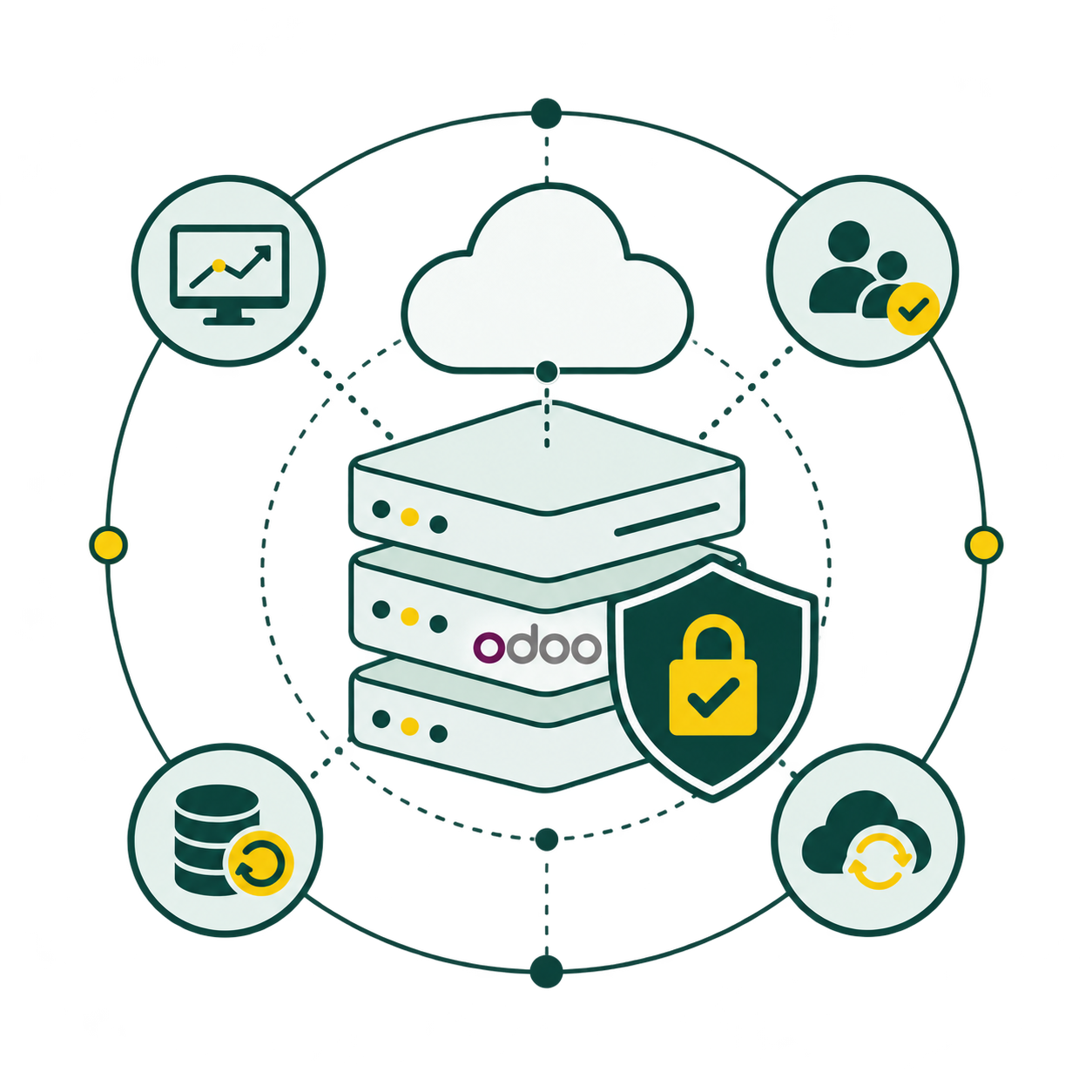
We analyse and evolve the infrastructure that supports Odoo and the applications your operations depend on. Performance, access, backups and recovery are part of the same responsibility: keeping your systems available, protected and ready to respond when something fails.
CLOUD AND SYSTEMS
Systems may be responding today and still accumulate problems that show up when activity increases or an incident occurs.
The ERP responds slowly when multiple users, orders, integrations or background processes coincide.
Shared accounts, unnecessary permissions or administrative privileges that no longer match real roles are kept.
It is not clear which components may be affected or how to check changes before taking them to production.
Data is saved periodically, but it is not always known what could be recovered, in what state or within what timeframe.
When an incident occurs, determining whether it comes from the application, the infrastructure, an integration or a third party delays the response.
OPERATIONAL CONTINUITY
Continuity is not improvised during an incident. It is prepared with a known architecture, useful signals, controlled access and defined recovery procedures.
Odoo, the database or an integration respond slowly or return errors.
Orders, stock movements or records between channels stop updating correctly.
The warehouse has no reliable statuses and customer service cannot confirm deliveries.
Invoicing, reconciliation and other processes are left pending or require manual checks.
You need to locate the source, coordinate owners and restore the affected systems.
SYSTEM DESIGN
A reliable infrastructure is not built by piling up security tools or adding resources every time a problem appears. At Studio73 we link the technical environment with the business processes that depend on it.
We analyse whether the infrastructure can handle the volume, concurrency, integrations and peak activity.
We review access, privileges, configurations and components according to the risk they represent.
We identify which signals reveal the state of the environment and locate degradations that need review.
We review which information must be protected, what recovery the company needs and which responsibilities must be defined.
CAPACITY AND GROWTH
Sizing an infrastructure is not about adding more power every time the system slows down. First you have to find where the limit is. That is why we locate the cause before deciding what needs to change.
We analyse how many people use the system, when they overlap and which operations they run.
We review automations, reports, synchronizations and background tasks competing for the same resources.
We study its size, growth, configuration and behaviour under the queries generated by real activity.
We check what information they exchange, how often and how their errors or delays affect the whole.
We consider new users, warehouses, companies, channels or applications that may change the environment’s needs.
SECURITY AND ACCESS
Access control must adapt to real roles, the criticality of the data and the consequences each action may have.
Security does not depend on a single tool. It requires combining access control, configuration, maintenance, detection and recovery capability.
STUDIO73 · a review that follows real work
THE JOURNEY OF AN ACCESS
Named accounts help avoid shared access and make it possible to maintain traceability.
Each user should only access the information and operations needed to do their job.
Accounts with greater capabilities require specific review and should be reserved for justified tasks.
Access must be reviewed when a person joins, changes responsibilities or no longer needs the system.
Development, testing and production should be kept separate when the project needs to prevent changes or test data from affecting real operations.
Keys and accounts used by integrations need owners, defined permissions and different treatment from personal access.
STARTING POINT
We review the application, database, infrastructure and integrations to locate the source of the problem.
Analyse performance →We review components, dependencies, configurations and priority risks.
Assess the infrastructure →We analyse what is backed up, how it is stored and what procedure exists to restore the systems.
Review the recovery strategy →We study permissions, identities, technical accounts and the limits of action between providers.
Review access and risks →METHODOLOGY
The scope, responsibilities and associated documentation are agreed before starting any technical change.
We identify the systems, the processes that depend on them and the interruptions that would have the greatest impact.
We rank risks and improvements by impact, urgency, effort and dependencies.
We define and apply the changes within scope on architecture, capacity, access, monitoring or recovery.
We check the agreed criteria and review needs when the real use of the system changes.
FAQ
No. The cloud provider protects certain infrastructure elements depending on the contracted service, but applications, access, permissions, data and many configurations still need control. Security depends on how responsibilities are split between the provider and the company, and on the defined measures being maintained and reviewed.
A backup keeps a version of the data. A recovery plan establishes what must be restored, in what order, who is involved and which applications, configurations and integrations are needed to operate again. A backup is one element of the plan, but it does not replace it.
We analyse concurrent users, data volume and growth, background processes, integrations and peak activity. We also review configuration and developments, because adding resources does not by itself fix a poorly designed process, an inefficient query or code that causes performance problems.
It is not enough to check that the backup has been generated. You need to verify that it is kept for the intended period and run restore tests at a defined frequency. It is also advisable to establish how much data can be lost and how long it can take to restore operations. These targets should be adapted to the importance of each system.
This must be analysed explicitly. Recovering a database may not be enough if servers, credentials, configurations, modules, domains or connections with other systems are also needed. The plan must identify dependencies and check which elements are needed to operate again.
RELATED SERVICES
Tell us which applications you use, what is failing or which risk you need to review. We will identify the main dependencies to determine whether the next step should focus on performance, capacity, access, monitoring or recovery.
Tell us about your situation →