Configure
When the functionality already exists, but it is not being used or configured correctly.
Integrations and custom development
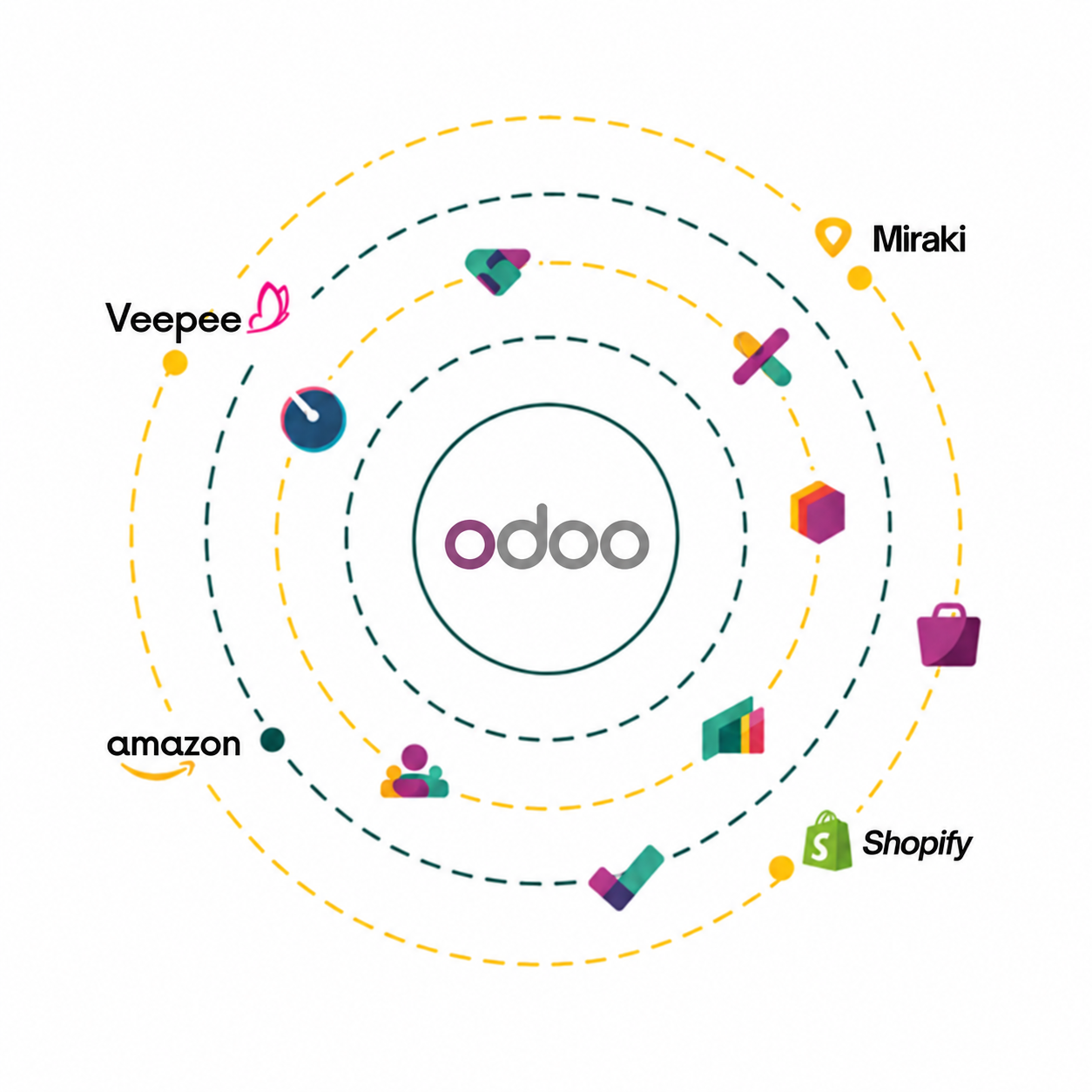
We connect Odoo with the applications that are part of your operations and only develop what provides a real advantage. Fewer manual tasks, less duplicated information and operations ready to evolve.
THE PROBLEM
This usually translates into:
Duplicated or different data depending on the tool consulted.
Orders, invoices or updates that have to be moved manually.
Errors that are hard to detect and correct.
Internal processes constrained by software limitations.
Dependence on specific people for information to flow.
Difficulty adding new channels, services or ways of working.
The problem is not always a lack of software. Often, what is missing is an architecture that makes information flow correctly.
WHEN IT MAKES SENSE
Not every need requires building software from scratch. We analyse the process, the tools involved and the possibilities each system already offers.
When the functionality already exists, but it is not being used or configured correctly.
When applications work, but need to exchange information to avoid duplication and manual tasks.
When the standard solution covers most of the need, but requires specific adjustments to fit operations.
When there is a differentiating need that cannot be solved maintainably with the previous options.
CONNECTED SYSTEMS
We connect the tools needed so data flows between departments, processes and applications without relying on manual tasks.
Opportunities, contacts, orders, price lists and sales activity connected with internal management.

Shipments, labels, tracking, deliveries and incidents coordinated with carriers and logistics platforms.

Connecting opportunities, contacts, orders and sales activity to reduce information fragmentation.

Documents, collections, payments and accounting data connected to speed up administrative processes.

Planning, manufacturing, equipment and execution information integrated into the workflow.

Portals, databases, in-house applications and business solutions connected through APIs, files, automations or middleware services.

Feasibility and scope are determined after studying the technical capabilities, restrictions and data quality of the platforms involved.
CUSTOM DEVELOPMENT
We make the most of what exists before writing custom code. We prioritize native Odoo configuration, the community (OCA), our Studio73 value layer and standard connectors. We only develop from scratch when your business really requires it.
We create solutions for:
Processes with rules, validations or approvals that don’t fit a standard flow.
Tools so teams and departments can work with the information they need.
Spaces for customers, suppliers or other partners connected to Odoo.
Interfaces to record, consult or update data where it is generated.
Automatic actions linked to conditions, statuses or company-specific rules.
Extensions that complete existing processes without altering the system’s core logic.
Connection layers that transform, validate and coordinate information between several systems.
Experiences adapted to specific tasks, profiles and contexts of use.
The goal is not to add code for the sake of it. It is to solve a real need with a solution that simplifies the process, can be maintained and evolves with the company.
Analyse my caseTECHNICAL QUALITY
A useful connection must also let you know what happened when an incident occurs.
That is why, when the project requires it, we consider:
Validation of the information exchanged.
Handling of incomplete or incorrect records.
Duplicate control.
Logging and traceability of operations.
Error handling and retries.
Review of permissions and access.
Testing before going into production.
Documentation needed to maintain and evolve the solution.
The level of control is adapted to the criticality of the process and the technical possibilities of each system.
FAQ
There is no universal compatibility. To assess feasibility, we check whether the system offers an API, connectors, webhooks, file exchange or other communication mechanisms. We also analyse access permissions, data structure, transaction volume, synchronization frequency and the maintenance conditions of the external system.
First we analyse whether the need can be solved with standard Odoo, configuration, automations, OCA solutions, the Studio73 Layer or existing connectors. We only propose specific development when those options don’t cover the process properly and the solution brings a real, sustainable and justifiable improvement to the business.
An API is a mechanism that allows two systems to exchange information. A connector uses an API, files, webhooks or another mechanism to carry out that exchange following a given structure. An integration designs the complete process: what data flows, which system owns each piece of information, what rules apply and how errors are controlled. Custom development creates or extends a feature that doesn’t exist in the available solutions.
Yes, as long as they still add value, can be connected reliably and make sense within the overall architecture. We don’t replace a tool without first analysing its function, maintenance cost, data quality and impact on the process.
The integration must define a main system for each type of information. For example, one system may own the catalogue and another invoicing or logistics. Editing permissions, update rules and conflict handling are also established. Without these decisions, a technical connection can increase duplicates and contradictory data.
Depending on the importance of the process, the solution may include data validation, operation logging, duplicate detection, alerts, retries and recovery mechanisms. These controls must be defined according to the scope, tested before going live and have clear owners to review incidents.
A documented architecture, with clear responsibilities and maintenance criteria, makes it easier to add new processes or systems. Even so, each future extension must be assessed according to its scope, complexity, compatibility and relationship with the existing solution. Technical feasibility does not remove the need for analysis and validation.
RELATED SERVICES
Tell us which tools you use, which process is creating manual work and what information you need to connect. We will study whether the right answer is to configure, integrate, adapt or develop.
Tell us which systems you need to connect →