You need a new ERP
The current system no longer lets you connect processes, control operations or support growth.
See Odoo implementation →ERP AND PRODUCTIVITY
Sales, operations, finance and teams should not work with different versions of the business.
WHEN INFORMATION DOESN’T FLOW
Activity goes on, but information remains scattered across the ERP, spreadsheets, emails and tools that don’t always communicate.
Each team keeps its own data and spends time checking which is correct.
Sales doesn’t always have a reliable view of stock, purchasing or capacity.
Needs and deviations are detected when they have already affected the next step of the process.
Before deciding, you have to gather data, review differences and confirm what happened.
THE CONNECTED PROCESS
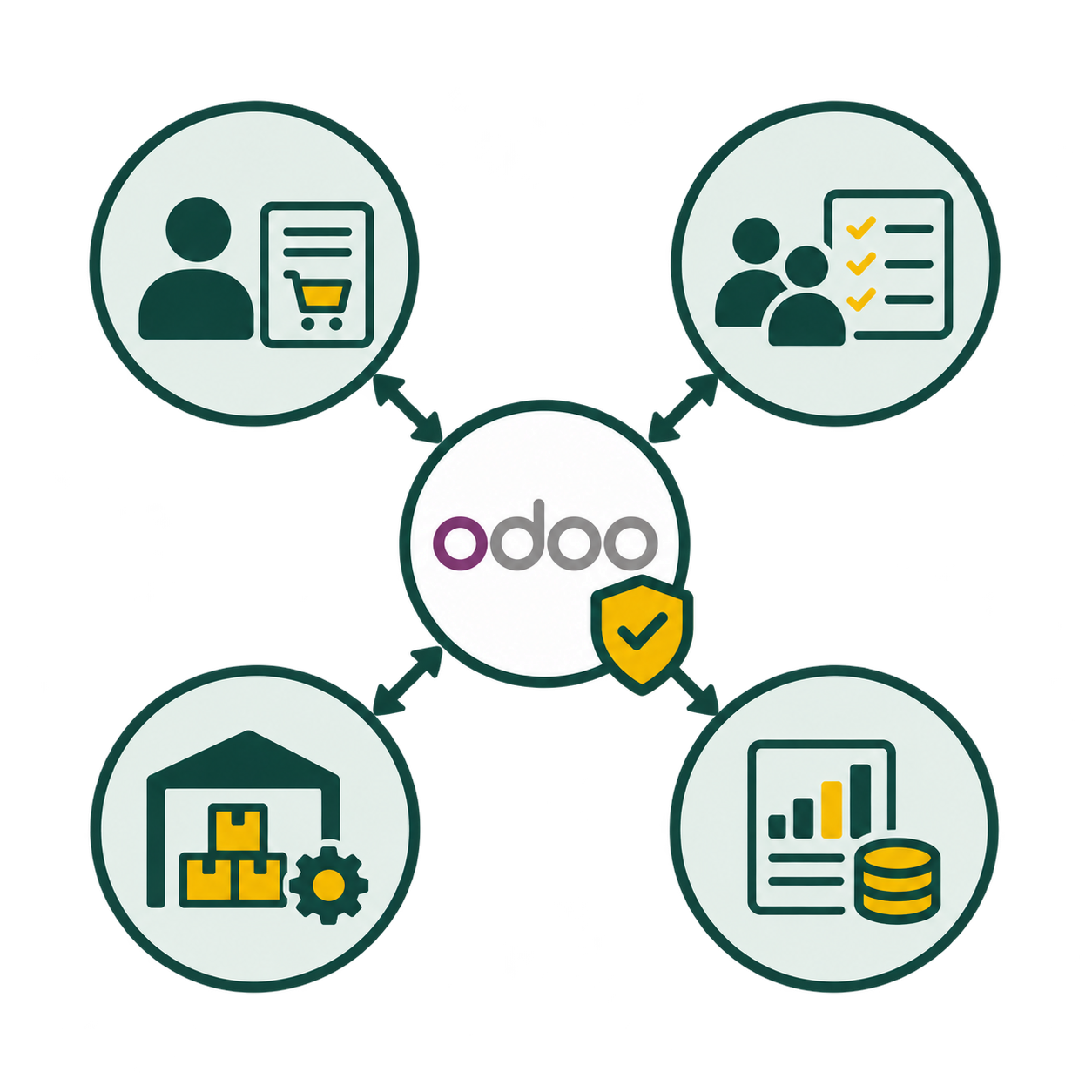
A sales transaction triggers decisions in several areas. When the system reflects the complete journey, each team can act with more context.
Quotation and order
Stock and commitments
Purchase, reservation or production
Movements and status
Revenue, costs and deviations
Data from real activity
WHERE TO START
The current system no longer lets you connect processes, control operations or support growth.
See Odoo implementation →There are issues, processes outside the system, conflicting customizations or insufficient adoption.
Rescue and evolve Odoo →We analyse the process to determine whether to implement, stabilize, integrate or prioritize a first improvement.
Start with consulting →AREAS WE CAN CONNECT
The starting point may be in a specific area or affect several. Explore the solution most related to your operations.
HOW WE WORK
We work on the complete journey, from the source of the data to the decision it should support.
Processes, information, exceptions and risks.
Systems, responsibilities and dependencies.
Standard first, development when it adds value.
Key users, data, training and support.
Follow-up based on real activity and new priorities.
FAQ
No. We analyse which processes should be centralized in Odoo, which tools still add value and which systems need to be connected. The goal is to build a coherent architecture, not to replace applications on principle. The decision depends on each tool’s function, data, integrations and maintenance cost.
Yes. The project can be organized by areas, processes or milestones, as long as dependencies are defined from the start. Splitting the implementation does not mean working with isolated departments. The data model, shared processes, owners and future connections must be considered from the first phase.
We compare the need with Odoo’s capabilities, configuration options, reusable solutions, OCA and the Studio73 Layer. We prioritize the standard when it solves the process properly. Specific development is reserved for relevant needs that cannot be covered adequately and maintainably with the available alternatives.
First we define which information must be kept and at what level of detail. Then we review its quality, set transformation rules and run tests before moving it. The migration must avoid duplicates, errors and structures that no longer match the current way of working. It is not always necessary to move the entire history.
It can be feasible when the applications involved offer APIs, connectors or other suitable connection mechanisms. The design must establish which system owns each piece of data, how often information is synchronized, how errors are handled and how process traceability is maintained.
Yes. We analyse the configuration, data, performance, developments, permissions and integrations to identify what should be fixed, kept or evolved. The result may be a stabilization plan, a prioritized improvement or a migration. We don’t assume that everything built needs to be replaced.
First we define what should improve and how it can be observed. For example, the number of duplicate records, manual steps, the time needed to find information or the number of issues in a process. The comparison is only useful if there is baseline data, people responsible for validation and a long enough period to observe real operation.
RELATED SERVICES
Tell us which areas are involved and what information your team still moves manually. We will propose the next step with functional and technical judgement.
Tell us about your challenge →