Skip to Content

Industry and manufacturing

Industrial control from planning to finished product

We analyse how your factory works and define a management solution on Odoo adapted to your processes, your data and the real capacity of your teams.

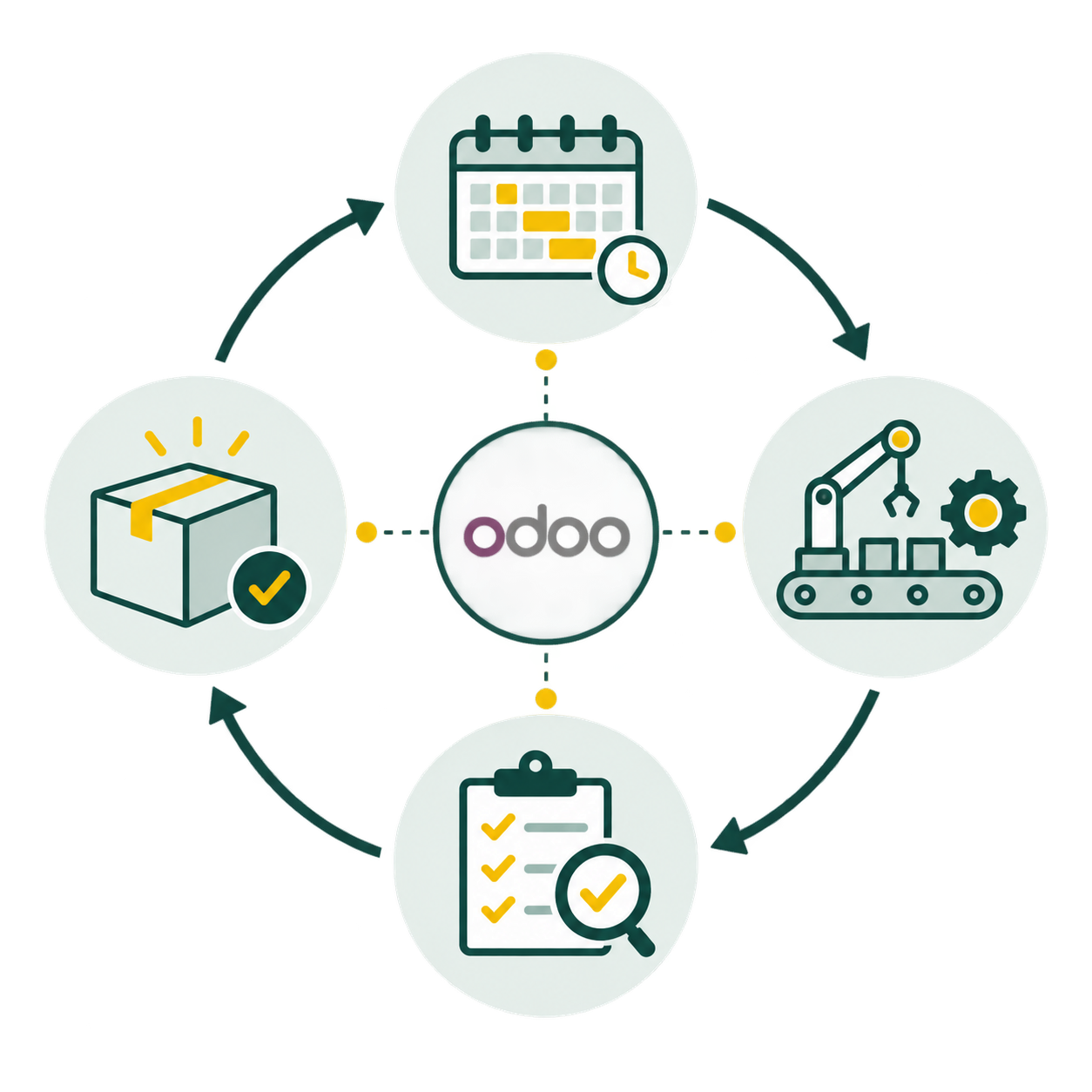
Cycle connected by Odoo: planning, production, quality and delivery

The industrial challenge

Planning must reflect what happens on the shop floor

A manufacturing order may be planned in the system and still not be executable as expected.

A component may be missing, a priority may change, a resource may be unavailable or an incident may occur that nobody records in time.

When product, materials, production and costs work with different information, problems appear in the form of:

When each area works with different information, you get:

  1. 01

    Delayed orders.

  2. 02

    Urgent component purchases.

  3. 03

    Consumption that doesn’t match the plan.

  4. 04

    Manufacturing times that are hard to know.

  5. 05

    Incomplete traceability.

  6. 06

    Costs calculated on estimates.

  7. 07

    Dependence on specific people to know what is happening.

The challenge is not to record more orders. It is to be able to decide with reliable information while production keeps running.

Production journey

One reading for product, shop floor and cost

Manufacturing is not controlled at a single point. It is controlled when the areas involved can work on the same information.

  1. 01

    Product and data

    What is manufactured, with which variants, materials and operations.

  2. 02

    Materials

    Which components are needed, when they must be available and what can block an order.

  3. 03

    Planning and capacity

    What must be manufactured, with which resources and in what sequence.

  4. 04

    Shop-floor execution

    Which operations have been carried out, what times and consumption have been recorded and what is still pending.

  5. 05

    Quality and traceability

    Which checks have been done, which incidents have appeared and which product may be affected.

  6. 06

    Industrial cost

    What was planned, what actually happened and where deviations occurred.

  7. 07

    Improvement

    Using data to review the process.

The goal is for production, purchasing and costing to work on a common basis.

How we intervene

First we understand the process. Then we define the system

Before configuring or developing, we analyse how the industrial operation really works.

  1. 01

    Understand

    We review how the product is defined, how orders are planned, how materials are managed and what information each team needs.

  2. 02

    Identify

    We find where information is lost, what blocks manufacturing and which data doesn’t reflect shop-floor reality.

  3. 03

    Define

    We set the scope, prioritize the standard and reuse, and reserve development for specific, justified needs.

  4. 04

    Validate

    We test the process with the teams involved, compare planning with execution and document the agreed criteria.

SUCCESS STORY

GANDIA BLASCOMANUFACTURING · DESIGN · OUTDOOR FURNITURE · INTERNATIONAL EXPORT
Gandía Blasco design and manufacturing project
GANDIA BLASCO × STUDIO73Connected manufacturing
+68.9%global traceability

Situation and intervention

GANDIA BLASCO combined design, manufacturing and international distribution with a rigid infrastructure and operations based on manual processes, paper and Excel files.

Studio73 evolved management into a common Odoo environment, connecting products, bills of materials, purchasing, manufacturing, inventory and international subcontracting.

The solution included:

  • Product and multi-level bills of materials.
  • Purchasing and subcontracting linked to production.
  • Centralized inventory and traceability.

Published results

  • −43.8% in data errors.
  • +68.9% in global traceability.
  • 62.4% of purchases automated.
  • Reports: from 2–3 days to less than 4 hours.
  • +36.2% growth absorbable without expanding the administrative team.
See the Gandía Blasco success story →

FAQ

Is Odoo suitable for any industrial company?

The answer is not the same for every company. Suitability depends on the production model, planning complexity, the traceability required, the number of sites and the level of control needed.

We analyse what Odoo can cover maintainably and which needs require other tools, integrations or specific developments.

Is it necessary to develop a specific solution?

Not always. We prioritize standard Odoo functionality, mature OCA solutions and reusable resources from the Studio73 Layer.

Specific development is considered when there is a relevant need, a clear business advantage and no suitable alternative that can be maintained reliably.

Can bills of materials and production data be migrated?

It can be feasible if the source information is available, structured and can be validated with the shop-floor team.

Before migrating we review references, bills of materials, operations, routings, work centres, units of measure, lots, serial numbers and other data within scope. The migration requires testing and acceptance before the information is used in production.

How is it implemented without putting production at risk?

We work in phases and validate processes, data and critical scenarios in test environments.

Go-live is coordinated with the production calendar and the operations that cannot be interrupted. The plan must define owners, acceptance criteria and what information must be available before the switch.

Can Odoo help to know the manufacturing cost?

It can help link material consumption, labour time, operations and other components defined in the company’s cost model.

The usefulness of the analysis depends on how consumption and times are recorded, the valuation rules and data quality. The cost generated on the shop floor and the subsequent financial analysis must stay coordinated, even though they belong to different areas.

Can Odoo be connected to machinery or shop-floor systems?

It depends on the interfaces available, the type of information to be exchanged and the conditions of the manufacturer or existing system.

Before proposing the connection, we define which data is needed, how often it must flow, who validates it and how errors will be handled. Not all equipment allows the same level of integration.

The next step

Connect planning with what really happens on the shop floor

Tell us how you manufacture, which systems you use and where you are losing visibility. We will analyse what Odoo can solve, what should stay, what needs to be connected and the safest way to approach the project.

Let’s talk about your production

A first conversation to assess your production model, shop-floor needs and the critical points of the implementation.