Commercial terms
determine revenue, invoicing and collection.
Financial and management control
Connect sales, purchasing, inventory, projects and accounting to analyse margins, locate deviations and understand which operations explain each result.
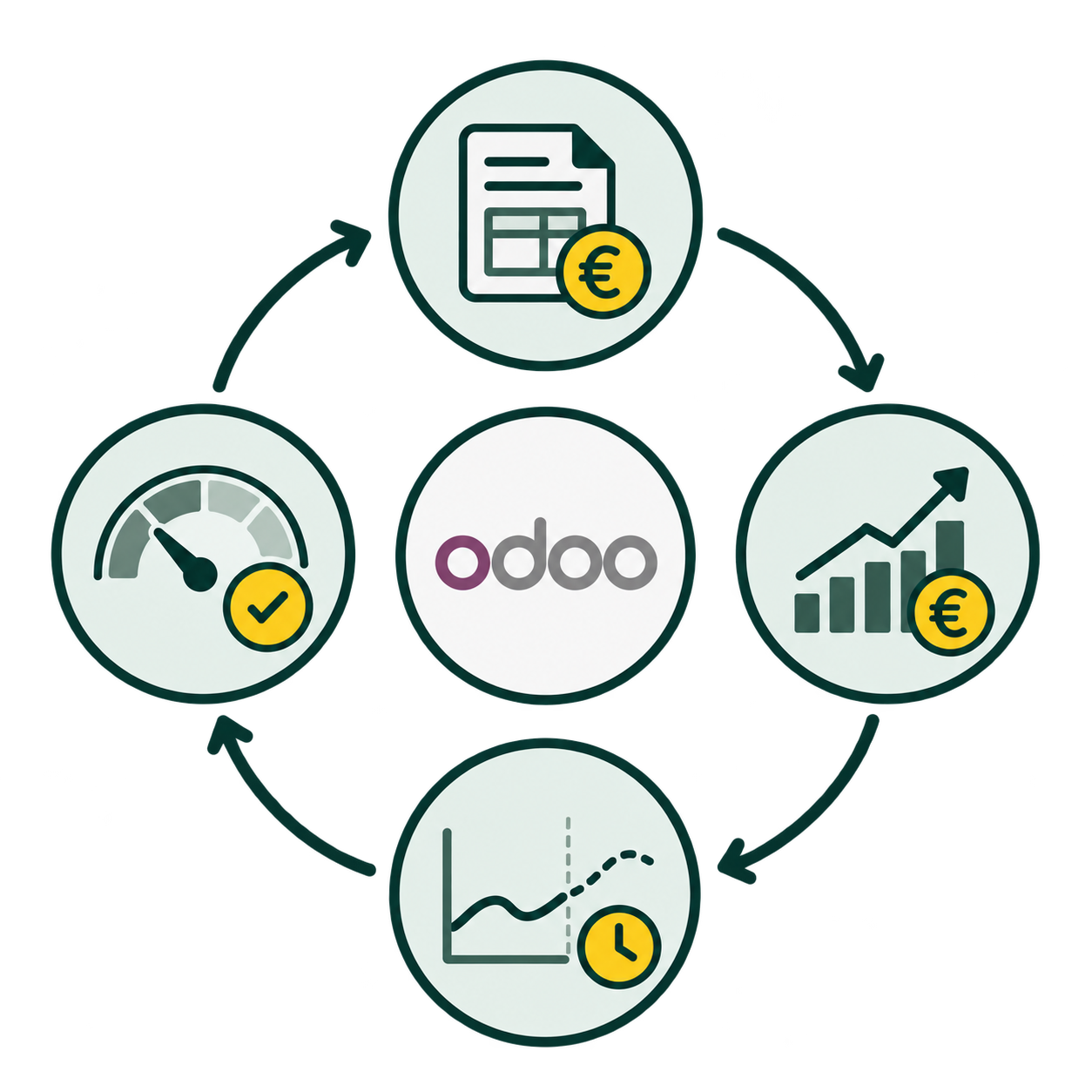
When the figure doesn’t explain the business
Financial information loses value when it arrives late, depends on several spreadsheets or changes depending on who prepares the report.
Data source
determine revenue, invoicing and collection.
are involved in calculating and recording costs.
make it possible to analyse the profitability of projects and services.
make it possible to compare execution with the plan.
organize this information for consultation and validation.
The goal is for management, finance and area managers to work with shared criteria
and trace a figure back to the operations that explain it.
Strategic questions
It is not about activating every available feature. It is about deciding what your company needs to control, where it gets the information from and which validations make it trustworthy.
We link orders, invoices, collections, payments and due dates to make it easier to monitor the financial position and detect items that need review.
We define the analytic dimensions needed to allocate revenue and costs, compare plan against execution and locate the source of differences.
We set criteria to link sales, purchases, hours, expenses, consumption and other operational data with the corresponding object of analysis. The depth of the calculation will depend on the information available and how each operation is recorded.
We configure the reconciliation flows and rules allowed by the implemented solution to identify reconciled movements, automatic proposals and items pending validation.
We structure companies, permissions and reporting criteria to analyse each entity separately and, when the scope and available capabilities allow it, obtain a coherent view of the group.
We design reports and views so that management can access the relevant information and authorized owners can consult the records involved in its calculation.
We configure the available capabilities according to the Odoo version, the installed localization and the obligations applicable to each company. Tax, accounting and audit decisions are validated with the client’s internal managers or competent advisers.
Starting point
We define the accounting and analytic structure, the dimensions of analysis and the relationship between finance and the rest of operations before configuring the solution.
Odoo implementation →We review data, configuration, reports and integrations to locate mismatches, duplicates, inconsistent criteria or tasks still being done manually.
Migration, stabilization and scaling →We adapt the structure to new companies, channels, warehouses, projects or business units, reviewing how these changes affect existing criteria.
ERP: Management and Productivity →How we work
We define, connect and validate the financial model so the knowledge stays with your team.
We identify the decisions it must support, the KPIs needed, the dimensions of analysis and the people responsible for using and validating the information. Result: agreed criteria and KPIs.
We review the processes, documents and applications involved to detect duplication, manual steps and differences in criteria. Result: a map of processes, sources and validation points within scope.
We define accounting and analytic criteria, responsibilities, permissions, approval flows and exception handling. Then we configure and integrate the planned solutions, prioritizing the alternatives that can be maintained and evolved most safely. Result: operating model and rules implemented.
We validate balances, allocations and reports using known data and scenarios before accepting changes or using the information to make decisions. In a migration, this validation may include prior rehearsals, transformation rules and comparison of balances and movements. Result: test evidence and acceptance criteria.
Knowledge stays with your team
Depending on the agreed scope, we deliver the documentation needed to understand the decisions implemented: financial model, calculation rules, validation flows and tests carried out.
When the work is part of a broader implementation, migration or rescue, these decisions are integrated into the Studio73 Method.
Deciding what is missing
Not every control need requires specific development. Before proposing it, we review the available alternatives in this order:
We reserve it for relevant requirements that are not responsibly covered by the previous alternatives.
We apply Studio73’s own components and criteria when they are suitable to solve needs already identified in other projects.
We evaluate available modules when they provide a maintainable solution compatible with the project architecture.
We start from the features of the implemented version and edition whenever they cover the need properly.
FAQ
Yes, if the dimensions of analysis, the information that must feed them and the people responsible for validating it are defined.
The level of detail will depend on how sales, purchases, hours, expenses and other costs are recorded. For the analysis to be useful, the data must be linked to the defined criteria and kept up to date.
Not necessarily. First we review the existing architecture, accounting processes, integrations and information needs.
From that analysis we determine whether to keep and integrate the systems, move certain processes to Odoo or set up a phased transition. The decision must also consider the company’s localization and obligations.
We run migration rehearsals, define transformation rules and compare balances, movements and known reports before going live.
The people designated by the company take part in the review and acceptance. Validation must leave a trace of the differences detected and the decisions taken.
No. Studio73 designs, implements and evolves the technology solution and the processes included in the project.
Tax, accounting and audit decisions must be validated with the company’s internal managers and competent advisers. Our job is to translate those criteria into the system when they are part of the technical scope.
Not always. First we review Odoo’s capabilities, configuration options and the solutions available in the ecosystem and in the Studio73 Layer.
Specific development is reserved for relevant needs that these alternatives don’t cover adequately and whose maintenance can be justified.
First we identify what information exists in each system, which data overlaps and which should be considered the main source.
Then we define the rules for exchange, reconciliation and validation. Integrating several sources without establishing these responsibilities can produce contradictory reports, even if the technical connection works.
RELATED SERVICES
The next step
Tell us what information management needs, how it is currently obtained and where the differences appear.
We will review the processes and data involved to identify the source of the problem and propose a next step suited to your company’s situation.
Tell us what you need to control →